
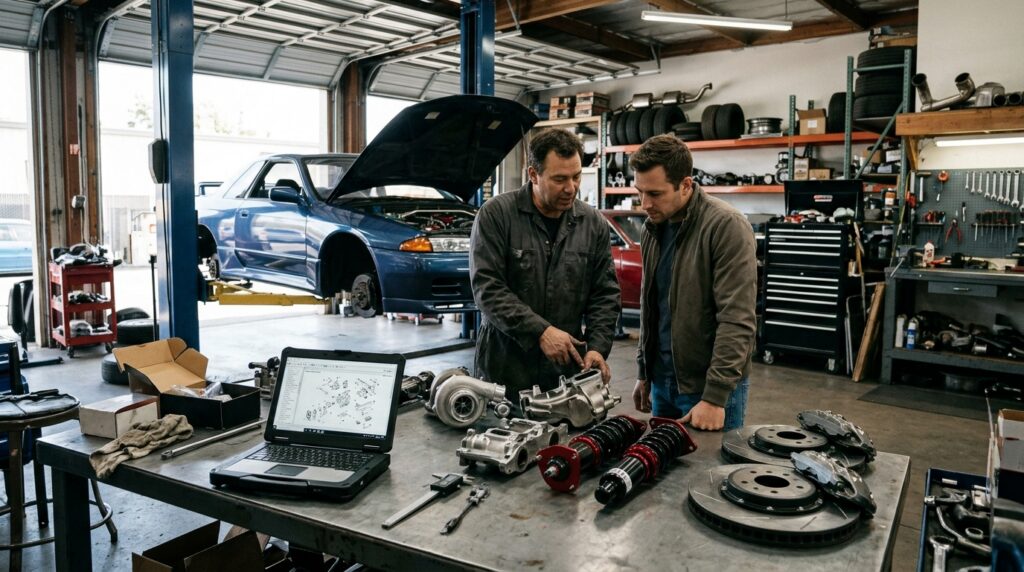
Finding the right Japanese import can be exciting, but the purchase price and vehicle condition are only part of the ownership equation. Before importing an older or discontinued Japanese car, buyers should also determine whether the parts needed to maintain and repair it are realistically available.
Parts availability for Japanese import cars varies dramatically. One model may share filters, bearings, sensors, and engine components with vehicles sold in the United States, while another may rely on Japan-only parts that have been discontinued for decades. A rare performance car may have excellent aftermarket support but almost no new factory body panels. A simple kei truck may be mechanically straightforward while still requiring imported model-specific trim or drivetrain components.
Researching this before purchase can help prevent a situation where an affordable import becomes difficult or expensive to keep on the road.
Why Parts Availability Matters Before You Import
Every older vehicle eventually needs repairs. Fluids, filters, belts, hoses, brakes, suspension components, bearings, sensors, gaskets, seals, and electrical parts all wear over time.
With a common domestic-market vehicle, a replacement part may be available locally the same day. With a Japanese domestic market vehicle, the same repair could require searching Japanese suppliers, locating a used component, identifying a compatible substitute, or waiting for international shipping.
This does not mean rare imports are bad purchases. It means buyers should understand the ownership environment before committing.
If you are still evaluating the vehicle itself, our guide on how to identify a quality imported car before buying can help with broader condition research.
Start With Routine Maintenance Parts
The first category to investigate is ordinary maintenance. A car that requires rare parts for every oil change or brake service can quickly become frustrating to own.
Before buying, research availability for:
- Engine oil filters
- Air filters
- Fuel filters
- Spark plugs
- Accessory belts
- Timing belts or timing-chain components
- Water pumps
- Thermostats
- Brake pads
- Brake rotors
- Wheel bearings
- Clutch components
- Engine and transmission mounts
- Common suspension bushings
If these basic items are easy to source, everyday ownership becomes much simpler.
 Look For Shared Components
Japanese manufacturers often used the same engine families, bearings, sensors, filters, and other components across multiple models and markets. A Japan-only vehicle may therefore use some parts that also appeared on cars officially sold in the United States.
Research the engine code, transmission code, chassis code, and original part numbers instead of searching only by the car’s model name.
For example, searching for a specific bearing or sensor number may reveal compatible applications that would not appear if you searched only for a Japanese-market vehicle.
Separate Mechanical Parts From Model-Specific Parts
One of the most useful ways to research availability is to divide parts into categories.
Mechanical maintenance items may be relatively easy to substitute or cross-reference. Body panels, headlights, interior trim, electronic modules, glass, weather stripping, dashboards, and model-specific brackets can be much harder.
Body Parts Can Be The Biggest Challenge
A vehicle may run perfectly yet become difficult to repair after a minor collision if replacement fenders, bumpers, lamps, trim pieces, or glass are unavailable.
Before importing a rare vehicle, check whether common collision parts are still sold new, reproduced by aftermarket companies, or available regularly through used-parts suppliers.
This becomes especially important for limited-production versions with unique bumpers, wings, headlights, or wide-body panels.
Interior Parts Can Be Surprisingly Difficult
Dash vents, switches, console trim, door panels, seat hardware, instrument clusters, window regulators, and weather seals may not receive the same aftermarket support as performance components.
These parts can also become brittle with age, making good used replacements increasingly valuable.
Use The Exact Chassis And Engine Codes
Import buyers should learn the specific chassis code of the vehicle they are considering. Searching only for a broad model name can produce inaccurate results because different generations and trims may use different mechanical components.
Engine codes matter for the same reason. Two versions of the same vehicle may look nearly identical while using different sensors, turbochargers, injectors, ignition systems, transmissions, or cooling components.
Save the chassis number, engine code, transmission code, and major factory part numbers before ordering anything.
Check OEM Parts Before Assuming They Are Discontinued
Older Japanese vehicles sometimes retain more factory support than buyers expect. Some components may remain available through Japanese dealer networks even when they are no longer stocked by U.S. dealers.
Availability can change, however, so a listing found online does not always mean the part is currently in production.
Whenever possible, confirm current availability rather than assuming an old catalog entry guarantees stock.
Heritage Parts Programs Can Help Some Older Models
Several Japanese manufacturers have created programs specifically to reproduce selected discontinued components for enthusiast vehicles.
Toyota’s GR Heritage Parts program reproduces selected discontinued genuine parts for older vehicles. Toyota currently lists support for models including the A70 and A80 Supra, AE86, Toyota 2000GT, and several Land Cruiser generations.
Toyota announced additional 2026 reproduction parts including components for the A70 Supra, A80 Supra, AE86, and Land Cruiser models.
NISMO Heritage Parts similarly supports selected older Nissan performance cars by reproducing discontinued genuine repair components. The program continued adding items during 2026.
Honda also launched Honda Heritage Parts as part of its Heritage Works initiative, supplying selected reproduction and compatible components for classic Honda performance vehicles.
These programs can make certain enthusiast models easier to maintain, but buyers should not assume that every component is reproduced. Check the exact model and part list.
Aftermarket Support Can Matter More Than OEM Supply
For some popular performance cars, aftermarket support is extensive enough that discontinued factory components may not create a serious problem.
Suspension components, brake upgrades, cooling systems, intercoolers, exhaust parts, clutch kits, engine gaskets, bushings, and performance hardware may be available from numerous manufacturers.
That can make popular enthusiast vehicles easier to own than rarer cars that originally sold in larger numbers but never developed strong aftermarket support.
Aftermarket Does Not Always Mean Direct Replacement
Be careful when assuming an aftermarket product is equivalent to the original part. Some components are designed as upgrades rather than direct replacements and may change ride quality, noise, emissions performance, or vehicle behavior.
For a collector-quality vehicle, aftermarket components may also affect originality and resale appeal.
Used Parts Can Become Essential
When new OEM and aftermarket parts disappear, used parts may become the primary option.
Japanese vehicle dismantlers and specialty exporters can be valuable sources for engines, transmissions, body panels, electronic modules, lamps, interior trim, suspension assemblies, and other discontinued components.
However, used parts come with additional risks. Electronic components may be untested, rubber parts may already be deteriorated, and shipping large items internationally can be expensive.
Research Availability Before You Actually Need The Part
Before purchasing the car, search for several difficult components as a test. Look for a headlight assembly, engine computer, window regulator, steering rack, transmission, body panel, and major suspension component.
If none of these can be found from multiple sources, that tells you something important about future ownership.
If dozens of suppliers carry them, the vehicle may be easier to support than expected.
Check Parts For Known Failure Points
Every older vehicle develops a reputation for certain recurring problems. Some engines have vulnerable sensors. Some transmissions develop synchro wear. Some models have fragile dashboards, aging electronic modules, weak window regulators, or specific cooling-system problems.
Research those weaknesses before importing the car and check the availability of the parts required to fix them.
A rare failure is less concerning when the necessary replacement is still easy to purchase. A common failure becomes far more important when the repair part is almost impossible to find.
Modified Cars Need A Different Parts Strategy
Modified vehicles may use a mixture of factory and aftermarket components from different manufacturers. A turbocharger might be from one company, the fuel injectors from another, and the ECU from a third.
Ask for documentation identifying the parts before purchase.
Our guide on what to check before importing a modified performance car explains why receipts, tuning records, and modification details are important.
Find Out Whether The Original Parts Are Included
Factory components can be valuable even if you do not plan to reinstall them immediately. Original air boxes, engine computers, wheels, suspension parts, exhaust systems, steering wheels, and trim may become difficult to replace later.
A modified car that includes its removed factory parts may therefore be more desirable than an identical car without them.
Rust Can Make Parts Availability Even More Important
Corrosion often damages more than the body shell. Rusted brake lines, fuel lines, brackets, suspension hardware, subframes, and fasteners may all need replacement.
If you are considering an older vehicle from a rust-prone environment, check whether those underbody components are available before committing.
Our guide on how to spot rust and corrosion on a Japanese import covers the areas that deserve the closest inspection.
Consider Shipping Cost And Delivery Time
A part may technically be available in Japan but still be expensive to obtain in the United States. Small components may be inexpensive to ship. Large bumpers, glass, body panels, exhaust systems, seats, and transmissions can cost significantly more.
Shipping time also matters when the car is your regular transportation. Waiting several weeks for a replacement component is very different when the vehicle is a weekend project rather than a daily driver.
 Build A Spare-Parts Budget
Buyers of older imports may benefit from setting aside money specifically for difficult-to-source components.
When the car first arrives, it may also make sense to purchase common maintenance items and known failure parts while they are still readily available.
This might include belts, hoses, filters, sensors, seals, ignition components, brake parts, or model-specific clips and trim pieces.
Buying sensible spares is different from accumulating every component you can find. Focus on items that commonly fail or would make the car unusable if unavailable.
Do Not Judge Parts Support Only By Online Search Results
A search engine result can show a product page long after the item has gone out of stock. Before using a part’s availability to justify a purchase, check whether suppliers can actually deliver it.
Contact specialty dealers or import-parts businesses when necessary and ask about lead times.
Community knowledge can also be useful. Owners’ clubs and model-specific forums often know which discontinued parts have substitutes, which suppliers still carry stock, and which components have become serious ownership problems.
Parts Availability Can Affect Insurance And Value
Rare parts may affect more than maintenance. Collision repairs can become expensive when body panels, lamps, or glass must be imported or sourced used.
Owners of rare vehicles should discuss valuation and repair considerations with their insurer.
Our guide on how to register and insure a Japanese import in the U.S. explains why documentation, valuation, and vehicle-specific information can matter when arranging coverage.
Create A Parts Availability Checklist Before Buying
Before placing a bid or sending payment, research at least the following:
- Oil and air filters
- Belts and cooling-system components
- Spark plugs and ignition components
- Brake pads and rotors
- Wheel bearings
- Clutch or transmission service parts
- Engine mounts
- Suspension bushings and dampers
- Sensors and electronic modules
- Headlights and tail lights
- Windshield and other glass
- Bumpers and common body panels
- Weather stripping
- Known model-specific failure items
For each item, note whether it is available as new OEM, reproduction, aftermarket, used, or compatible with another model.
Questions To Ask Before Importing A Hard-To-Support Car
- Are routine maintenance parts available locally?
- Which components are Japan-only?
- Are important factory parts discontinued?
- Does the manufacturer operate a heritage-parts program?
- Is there strong aftermarket support?
- Are used components commonly available?
- What parts are known to fail on this model?
- Can those parts currently be purchased?
- Does the car share components with U.S.-market vehicles?
- Are large body or drivetrain parts practical to ship?
- Are original parts included with modified vehicles?
- Is there a specialist mechanic familiar with the model?
Final Thoughts
Parts availability should be researched with the same care as auction condition, rust, import eligibility, and purchase price. A Japanese car can be mechanically excellent when purchased but still become difficult to own if routine or model-specific components are nearly impossible to source.
Start with ordinary maintenance parts, then investigate major mechanical components, electronics, body panels, glass, trim, and known failure items. Search using exact chassis, engine, and factory part numbers rather than relying only on the model name.
Manufacturer heritage programs from companies such as Toyota, Nissan, and Honda are making selected older vehicles easier to support, while strong aftermarket communities can keep other models viable long after factory production ends. However, support varies considerably from one car to another.
The best time to discover that a crucial part is unavailable is before you purchase the car, not after it is sitting in your garage waiting for a repair. A little parts research before importing can give you a much more realistic picture of what long-term ownership will actually involve.