
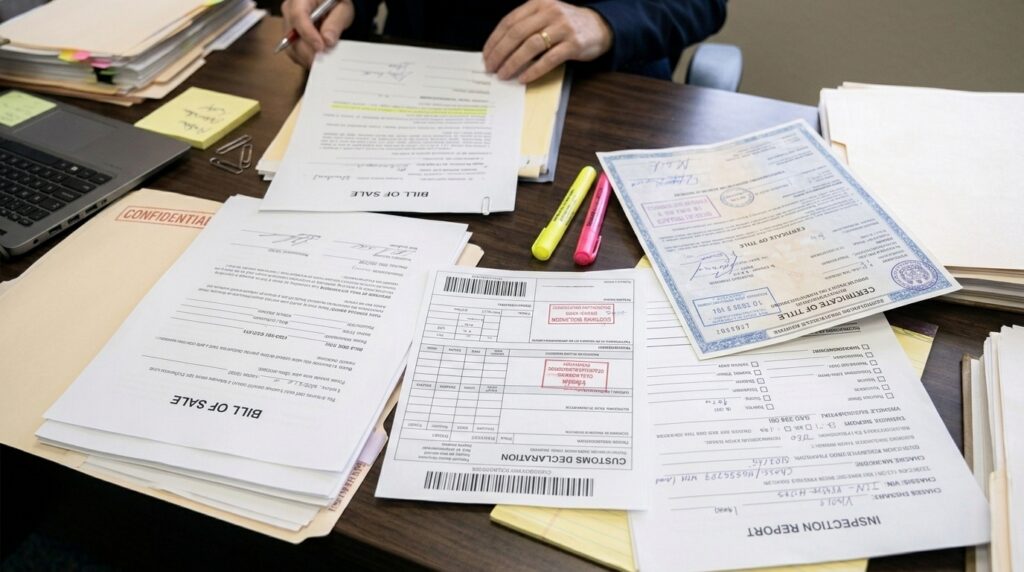
Getting a Japanese import through customs is a major milestone, but it does not necessarily mean the vehicle is ready for the road. After the car arrives in the United States, owners still need to work through state registration, title requirements, insurance, vehicle identification issues, and sometimes inspections or emissions requirements.
Learning how to register and insure a Japanese import before the vehicle arrives can make this stage much easier. Imported vehicles often come with documents and identification formats that are unfamiliar to local DMV offices and insurance companies. Older Japanese cars may also use chassis numbers that do not follow the standard 17-character VIN format found on vehicles originally manufactured for the U.S. market.
The exact process varies by state, so buyers should research their own DMV requirements before purchasing the vehicle. Still, several documents and preparation steps apply broadly and can help prevent unnecessary delays.
Registration Starts Before The Car Reaches The DMV
 One of the biggest mistakes an import owner can make is waiting until the car arrives before thinking about registration. The paperwork needed for a state title often begins with the documents generated during the purchase, export, shipping, and customs process.
Keep original documents organized from the moment the vehicle is purchased. Replacing foreign paperwork after the car has left Japan can be difficult, and incomplete records can complicate registration.
If you are still preparing for shipment, our guide on verifying an imported car’s VIN, recall history, and paperwork explains how to compare vehicle identification information before purchase.
Gather Your Import Documents Before Visiting The DMV
Although requirements differ among states, imported vehicles commonly require more supporting documentation than a typical domestic used-car purchase. Owners should create a complete file rather than arriving at the DMV with only the foreign title and bill of sale.
Useful records may include:
- Foreign title or Japanese export certificate
- Certified translation when required
- Purchase invoice or bill of sale
- Bill of lading
- Customs entry documentation
- EPA documentation
- DOT or NHTSA documentation
- Proof of ownership
- Vehicle inspection paperwork
- Insurance information
- Copies of identification and residency documents required by your state
U.S. Customs and Border Protection provides guidance on importing vehicles and the documentation associated with clearing a vehicle through customs.
Keep The Original Foreign Documents
Do not discard the Japanese export certificate, deregistration certificate, or other original ownership documentation after customs clearance. State agencies may need those documents when establishing ownership and issuing a U.S. title.
Make high-quality digital scans as backups, but keep the originals protected. Documents should also be compared carefully to the vehicle itself. The chassis number, model information, and other identifying details should be consistent across the records.
Understand The Chassis Number And VIN Issue
Japanese domestic market vehicles can create confusion because many were not manufactured with the 17-character VIN format familiar to American vehicle databases. Instead, they may use a shorter chassis or frame number.
NHTSA explains that vehicles manufactured for sale in the United States are assigned standardized 17-character VINs. Imported vehicles built for another market may therefore require additional review by state registration authorities.
Owners can use the NHTSA VIN Decoder for vehicles with compatible VINs, but a Japanese chassis number may not return normal results.
Do Not Invent Or Alter A VIN
A buyer should never add characters, modify a chassis number, or create a 17-digit VIN simply because an insurance or registration system expects one. Vehicle identification must match official documents and any identification physically attached to the car.
If a DMV database cannot accept the vehicle’s existing identification number, ask what state-specific procedure applies to foreign vehicles. Some states may require additional verification or inspection.
Confirm The Vehicle Was Legally Imported
State registration does not replace federal import compliance. The registration agency may want evidence that the vehicle legally entered the United States before issuing a title.
NHTSA provides federal vehicle import guidance, while the EPA explains emissions-related import requirements.
For older Japanese vehicles, many enthusiasts are familiar with the federal 25-year safety exemption. However, federal eligibility does not automatically answer every state registration question.
Our 25-year import rule guide explains the federal side in more detail.
State Registration Rules Can Be Different
The United States does not have one universal DMV registration process. Each state administers its own titles, registration procedures, inspections, fees, and insurance requirements.
This means a Japanese import that can be registered relatively easily in one state may require additional documentation or testing in another.
California Requires Additional Research
California is a useful example of why buyers should research their destination state before importing a vehicle. The California DMV maintains specific guidance for directly imported vehicles, including documentation showing customs clearance and compliance with applicable requirements.
California also has its own emissions rules, which can create additional considerations beyond federal import eligibility.
A buyer should therefore avoid assuming that federal eligibility automatically guarantees registration in every state.
Complete Any Required Vehicle Verification
A state may require physical verification of the vehicle before issuing registration. The inspector may compare the chassis number or VIN against the ownership and customs documents.
This makes document consistency particularly important. Differences caused by translation, typographical errors, or incorrect paperwork can delay registration.
Before the appointment, locate every identifying number on the vehicle and make sure it can be read clearly. Do not alter identification plates or remove factory markings.
Check For Theft Or Salvage Records When Possible
The National Insurance Crime Bureau VINCheck tool can search participating insurer records for certain theft and salvage information. NICB notes that its database is not a comprehensive vehicle history report, so it should be considered one research tool rather than definitive proof of history.
For Japanese-market vehicles with nonstandard chassis numbers, database coverage may also be limited.
Insuring A Japanese Import Can Require Extra Preparation
Insurance is often the next challenge. A conventional insurer may be able to quote a common U.S.-market vehicle instantly because its databases already contain the make, model, VIN format, repair costs, safety equipment, and claims information.
A Japanese domestic market import may not exist in those systems.
That does not mean the vehicle is uninsurable. It means the owner may need to provide more information manually or speak with an insurer familiar with collector, specialty, classic, or imported vehicles.
The National Association of Insurance Commissioners provides consumer information about auto insurance, including liability, comprehensive, collision, underwriting, and vehicle valuation considerations.
Start Shopping For Insurance Before Registration Day
Do not wait until the DMV appointment to begin calling insurers. Some states require proof of insurance before registration can be completed.
Start by explaining clearly that the vehicle is a legally imported Japanese-market automobile. Provide the year, manufacturer, model, chassis number, engine information, and ownership documentation.
If the first representative cannot find the car in the company’s system, ask whether the company has a specialty or collector-vehicle department.
Prepare An Insurance Documentation Package
An insurer unfamiliar with the vehicle may request additional evidence about what it is and what it is worth.
A useful insurance file can include:
- Foreign ownership documents
- U.S. title if already issued
- Customs clearance documents
- Purchase invoice
- Japanese auction sheet
- Exterior photographs
- Interior photographs
- Engine-bay photographs
- Chassis-number photographs
- Underbody photographs
- Modification receipts
- Recent appraisal if appropriate
If the car was purchased through auction, our guide on reading a Japanese auction sheet can help you understand the condition information available in that document.
Ask How The Insurer Will Value The Vehicle
Valuation deserves special attention with rare imports because there may be few directly comparable vehicles for sale in the United States.
The NAIC recommends asking an insurer how the value of a vehicle will be determined if the car is totaled. That question is especially important for a rare Japanese import where market prices may vary significantly depending on condition, originality, mileage, modification history, and documentation.
Do not assume that the amount you paid to import the vehicle will automatically be the amount paid after a covered total loss.
Keep Evidence Of Market Value
Maintain records supporting the vehicle’s value. These can include the purchase invoice, auction results, comparable sales, professional appraisals, restoration receipts, modification invoices, and detailed photographs.
This information may also be useful later if the car appreciates or if significant restoration work increases its value.
Discuss Modifications With The Insurance Company
If the car has an aftermarket turbocharger, wheels, suspension, body kit, engine modifications, upgraded brakes, or other significant changes, disclose them when requested by the insurer.
Modifications can affect vehicle value, repair costs, and underwriting.
A heavily modified car should also be inspected carefully before purchase. Our guide on what to check before importing a modified performance car covers engine tuning, suspension, exhaust, brakes, and supporting documentation.
Do Not Forget Rust And Existing Condition
Insurance does not remove the importance of knowing the vehicle’s current condition. Older Japanese imports can have rust, previous accident repairs, worn mechanical components, or modifications that should be documented when the vehicle arrives.
Take detailed photographs before regular use begins. Pay particular attention to the body, interior, wheels, glass, engine bay, and underbody.
Our article on spotting rust and corrosion before importing a Japanese car explains the areas buyers should inspect most closely.
Keep Customs Registration And Insurance Records Together
 Once registration and insurance are complete, create one permanent ownership file containing all major documents.
This can include:
- Japanese export certificate
- Certified translations
- Purchase invoice
- Bill of lading
- Customs documents
- EPA and NHTSA-related documents
- State title
- Registration
- Insurance policy information
- Inspection records
- Auction sheet
- Service records
- Modification receipts
This file can make future insurance claims, registration renewals, resale, and ownership verification much easier.
Common Registration And Insurance Mistakes
Waiting Until The Vehicle Arrives To Research The DMV
State requirements should be investigated before purchasing the car. Discovering a major registration obstacle after international shipping has already been paid for can create an expensive problem.
Losing Original Japanese Documents
Foreign ownership records may be difficult or impossible to replace quickly. Keep originals protected.
Assuming A Short Chassis Number Is An Error
Many Japanese-market cars legitimately use identification formats that differ from U.S.-market vehicles. Verify the number instead of trying to change it.
Choosing Insurance Only By Premium
Price matters, but coverage terms, deductibles, vehicle valuation, permitted use, repair provisions, and policy exclusions also deserve attention.
Failing To Update The Insurer After Major Changes
Restoration or expensive modifications can substantially change what the vehicle is worth. Ask your insurer whether the policy needs to be updated.
Registration And Insurance Checklist
- Confirm federal import eligibility before shipping
- Keep the Japanese export certificate and purchase records
- Retain customs clearance documents
- Verify the chassis number across every document
- Research your state’s direct-import registration requirements
- Complete any required VIN or vehicle inspection
- Research emissions requirements in your state
- Contact insurers before the registration appointment
- Prepare photographs and valuation documents
- Ask how a total-loss value would be calculated
- Disclose relevant modifications when requested
- Keep copies of all final registration and insurance records
Final Thoughts
Importing a Japanese car does not end when the ship reaches the United States. Registration and insurance are the final steps that turn an overseas purchase into a vehicle that can be legally owned and driven under the rules that apply where you live.
The smoothest process begins with good documentation. Keep the original Japanese ownership records, customs forms, purchase documents, and vehicle identification information together. Research your state’s registration requirements before the car arrives, particularly if your vehicle uses a short Japanese chassis number or was never originally sold in the United States.
Insurance also deserves early planning. A rare Japanese import may not fit neatly into a standard vehicle database, so owners should be prepared to provide photographs, import documents, auction records, modification information, and evidence supporting the car’s value.
Most importantly, remember that federal import eligibility, state registration, and insurance are related but separate issues. Completing one does not automatically guarantee the others. Researching all three before committing to a vehicle can help reduce delays and make the transition from Japanese auction or exporter to American road ownership considerably smoother.